Agentagon

The Spend OS for AI agents.

Sits before every agent call. Checks the agent, owner, team budget, provider, policy, approval, and receipt — in that order, every time. Govern LLM spend today. Agent-driven API and tool spend tomorrow. One control plane for both.

See Mission Control

Agents spend money. Agentagon governs money.

Protocols solved how agents pay.
Nobody solved who decides.

Payment rails like x402, MPP, and Stripe move money for agents just fine. None of them tell you who can spend, with what budget, on which providers, or with what audit trail. As every API call becomes a paid call, that gap shows up on the bill.

Spend you can't see

Your agents are calling OpenAI, Anthropic, Stripe, x402 endpoints, vector DBs, and dozens more. Spend is scattered across vendor dashboards, on-chain transactions, and monthly invoices. You learn the bill at month-end, not in the moment.

Policies you can't enforce

Any agent can call any provider for any amount. No team budgets, no employee delegation, no provider allowlists, no approval thresholds. One runaway prompt and you're explaining a five-figure invoice that nobody approved.

Audit you can't produce

Finance asks "who spent this?" and you have an account ID. Compliance asks for a control matrix and you have a hunch. Reconciling Stripe, x402, MPP, and ERP every quarter is a manual, error-prone fire drill.

40%
of enterprise apps will run AI agents by 2026
Gartner, 2025
$15T
B2B spend intermediated by agents by 2028
Gartner, 2025
1 in 4
developers already build for AI agents
Postman State of API 2025

Every dollar of AI spend is becoming agentic spend.

From the LLM call to the SaaS API to the x402 endpoint, the same agents are spending across every layer. The boundaries are dissolving fast. One control plane has to govern all of it.

Today

LLM tokens

Most enterprise AI spend is still OpenAI and Anthropic invoices. Easy to track at the org level, hard to attribute by team, harder to cap before the bill arrives. One enterprise we work with spends $2M+ a year here alone.

Emerging

Paid SaaS APIs through agents

Agents are calling Apollo, Stripe, Pinecone, and a long tail of paid APIs on behalf of teams. Subscriptions, API keys, and corporate cards stretched across surfaces nobody owns. Most of every subscription goes unused.

Coming fast

Agentic commerce endpoints

x402, MPP, and MCP-paid tools let agents pay any provider, per call, without a checkout. Volume is small today and explosive in 18 months. Every one of those calls needs the same governance as the LLM bill.

Ramp manages AI spend from the finance stack.
Agentagon governs it from the agent runtime.

Ramp, Brex, Airbase, and Coupa understand AI spend at the invoice layer — providers, models, cards, approvals, reconciliation. That validates the market. But autonomous agent spend has to be governed before the agent acts, not only before the bill hits. Different primitive, different product.

Finance stack

Ramp's primitives

Employees, vendors, cards, invoices, finance workflows. The decision happens after the agent has acted — on the statement, in the approval queue, at month-end close.

Agent runtime

Agentagon's primitives

Agents, tasks, tool calls, policy checks, budget reservations, protocol payments, audit receipts. The decision happens when an agent is about to call a paid API, invoke a paid MCP tool, start an MPP session, or hit an x402 endpoint.

One client. Every provider.
Every policy enforced.

Drop the Agentagon client into your agent and replace your provider calls with client.call(). Every invocation is checked against your team budgets, agent caps, and provider allowlists before a dollar moves.

Drop-in client Policy enforced
import agentagon

client = agentagon.Client(pat="ag_pat_...")

# Every call is policy-checked before it spends a dollar.
result = client.call(
    provider="openai",
    payload={"model": "gpt-5", "input": "..."},
)

# Spend logged. Budget tracked. Audit ready.
# Over a cap? Routed to your approval queue automatically.

A control plane for autonomous spend.

Six surfaces, one workspace. Built for the people accountable for AI agent spend, security, and audit.

Mission Control

The pane that finance, IT, and eng all share.

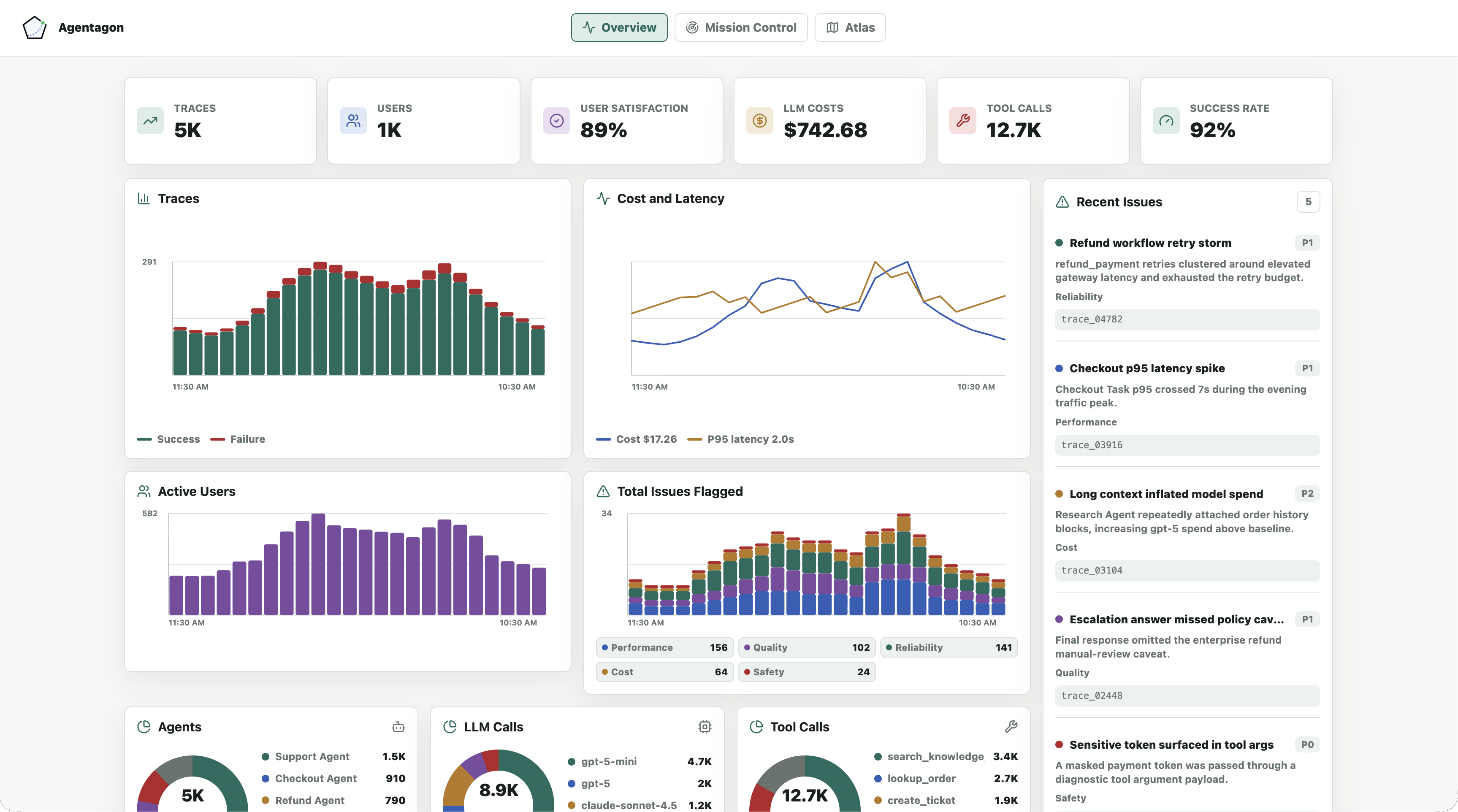
Real-time spend, policy adherence, active agents, approvals pending, blocked events. Spend trend by day. Breakdowns by team, employee, agent, and provider. One source of truth for the whole org.

Governance

Five layers of policy. RBAC by default.

Team budgets, employee delegation, agent caps, provider allowlists, approval thresholds. Escalation chain runs Agent to Employee owner to Team budget owner to CFO/CTO. Everything is enforced before a dollar moves.

Provider Marketplace

Curated catalog with pricing, latency, ROI.

OpenAI, Anthropic, Stripe, Plaid, Pinecone, Serper, Context7, and more. Each one shows protocols supported, pricing model, p50 latency, approval status, and ROI score. Route spend over the right rail without hand-rolling integrations.

Multi-rail Payments

One ledger across every rail.

x402 and MPP for HTTP-native and machine payments. Stripe and Plaid for cards, settlements, and bank context. Live USDC balances on Base and Solana. Top up, pay, and reconcile in one place.

Approvals

Human-in-the-loop, by severity.

High, Medium, Low queues by spend impact. Approve in dashboard, Slack, or via API. Agents pause on approval, resume on approve, deny on deny, all with full audit trail. No more screenshots in a Slack thread.

Audit & Integrations

Wired into the systems you already run.

Audited event ledger with CSV export. ERP export to NetSuite. SSO and SCIM via WorkOS. Slack notifications. MCP for tool interop. Compliance-ready reports for finance and security.

Cost Optimization · Roadmap

Recommends cheaper alternatives. Learns from your spend.

Once your data is flowing, Agentagon surfaces lower-cost provider and model alternatives at par quality, and learns from spend patterns to optimize ROI. Same prompt routed to a model that costs 60% less — with your policy still in front.

From scattered AI spend to one control plane.

1

Connect your rails

Stripe, Plaid, x402, MPP. Live in minutes via SDK or proxy. No infra to host, no chains to learn. Your existing providers and accounts plug straight in.

2

Set policies and budgets

Create teams. Delegate to employees. Mint agents. Cap spend, allowlist providers, set approval thresholds. The 5-layer policy stack runs on every call.

3

Deploy agents through Agentagon

Use agentagon.Client(pat=...).call(...) in your code. Every call is policy-checked, budget-enforced, and audit-logged before it lands at the provider.

4

Watch Mission Control

Real-time spend, blocked events, approvals queue, and audit log. Alerts in Slack. Exports to ERP. Finance, IT, and engineering see the same data, scoped to what they own.

CFOs, CISOs, and VPs of Engineering deploying agents in production.

Every other spend tool assumes a human at a checkout. Agentagon assumes an agent at an API.

📊

Finance gets a single ledger. Every rail, every provider, every agent, in one audited stream. Reconcile in minutes, not weeks. Export to NetSuite or your warehouse.

🔒

Security gets a real control plane. RBAC, SSO, SCIM, allowlists, kill switches. Block a runaway agent in one click. Produce an audit trail on demand.

Engineering gets to ship. One SDK call replaces a checkout flow per provider, a wallet per chain, and a billing integration per rail. The infrastructure is already there.

The agents are landing.
The controls aren't.

40%

Agents are going to production

40% of enterprise apps will run task-specific AI agents by end of 2026, up from less than 5% in 2025. Each agent generates thousands of paid calls per minute.

Gartner, 2025
$15T

Agents are spending real money

$15T of B2B spend will be intermediated by AI agents by 2028. Today, almost none of it is governed, audited, or capped at the agent layer.

Gartner, 2025
1 in 4

The infrastructure is racing to catch up

25% of developers now design APIs for AI agents. Payment rails are maturing fast (x402, MPP, ACP). The control plane is the missing layer.

Postman State of API 2025

Common questions.

Where do my agents run?
Wherever you want. Agentagon is the control plane, not the runtime. Run agents on your own infra, in any framework or language. Calls go through the Agentagon client; the rest of your stack stays put.
Which payment rails do you support?
x402 and MPP for machine-native payments. Stripe and Plaid for cards, settlements, and bank context. ACP and AP2 are on the roadmap. New rails ship without changing your code, just like new providers in the marketplace.
How does policy enforcement actually work?
Every call passes through a 5-layer check before reaching the provider: team budget, employee delegation, agent cap, provider allowlist, and approval threshold. Allowed calls go through. Over-cap calls go to the approvals queue. Disallowed calls get blocked and logged.
Who approves over-budget calls?
You configure it per policy. The default escalation chain is Employee owner, then Team budget owner, then CFO or CTO. Approvers act in the dashboard, in Slack, or via API. Agents pause until a decision lands.
Where is the money held?
Your choice. Use Agentagon-managed sub-wallets per agent for zero setup, or bring your own treasury and we sign with your keys. USDC on Base and Solana today, fiat rails via Stripe.
SOC2, SSO, audit?
SOC2 in progress with our design partners. SSO and SCIM via WorkOS, available in beta. Every call writes to an audited event ledger with CSV export and ERP push to NetSuite.
Do I need this if my agents only call OpenAI today?
Yes, for two reasons. First, today's LLM bill needs the same per-team and per-agent budget enforcement we'd apply to any other rail. Second, the SaaS APIs and x402 endpoints are coming fast. The control plane that governs both is cheaper to install once than retrofit later.

Take control of agent spend before it controls you.

We're onboarding design partners deploying AI agents in production, including teams already spending $2M+/year on AI. If finance, security, or engineering owns this surface at your company, we want to talk.